The Ukrainian fish market is adapting to war, blackouts, and more expensive logistics. Consumption has not fallen, but some types of fish may become more expensive.
In 2026, Ukrainian consumers risk getting used to a new scenario: some types of fish will gradually transform from an everyday product into a more expensive category of regular purchases.
The key question is not whether prices will rise, but how quickly and who will be the first to "rewrite" their eating habits: households, HoReCa, or the suppliers themselves.
Currently, the domestic fish market operates in a mode of constant compromise between exchange rates, logistics, and energy. But despite the war, blackouts, and more expensive delivery, consumption has not "collapsed": imports in 2025 almost repeated pre-war volumes, and sharp price jumps occur rather selectively than across the entire shelf at once.
Dmytro Zahumennyi, CEO of the Association of Ukrainian Importers of Fish and Seafood, told UNN about what exactly forms the final cost for the buyer, how businesses adapt to outages, and why certain types can double in price.
Fish Basket-2026: Why Prices Hold, What Shakes Them, and Where Mackerel "Shoots Up"
The Ukrainian fish market operates in a mode of constant adaptation to three things that no market participant controls:
- exchange rate;
- logistics;
- energy.
Despite the war, power outages, and more expensive delivery, there has been no massive collapse in consumption, according to Dmytro Zahumennyi.
In 2025, import volumes generally remained close to previous periods, and sharp price jumps were rather localized and affected individual items.
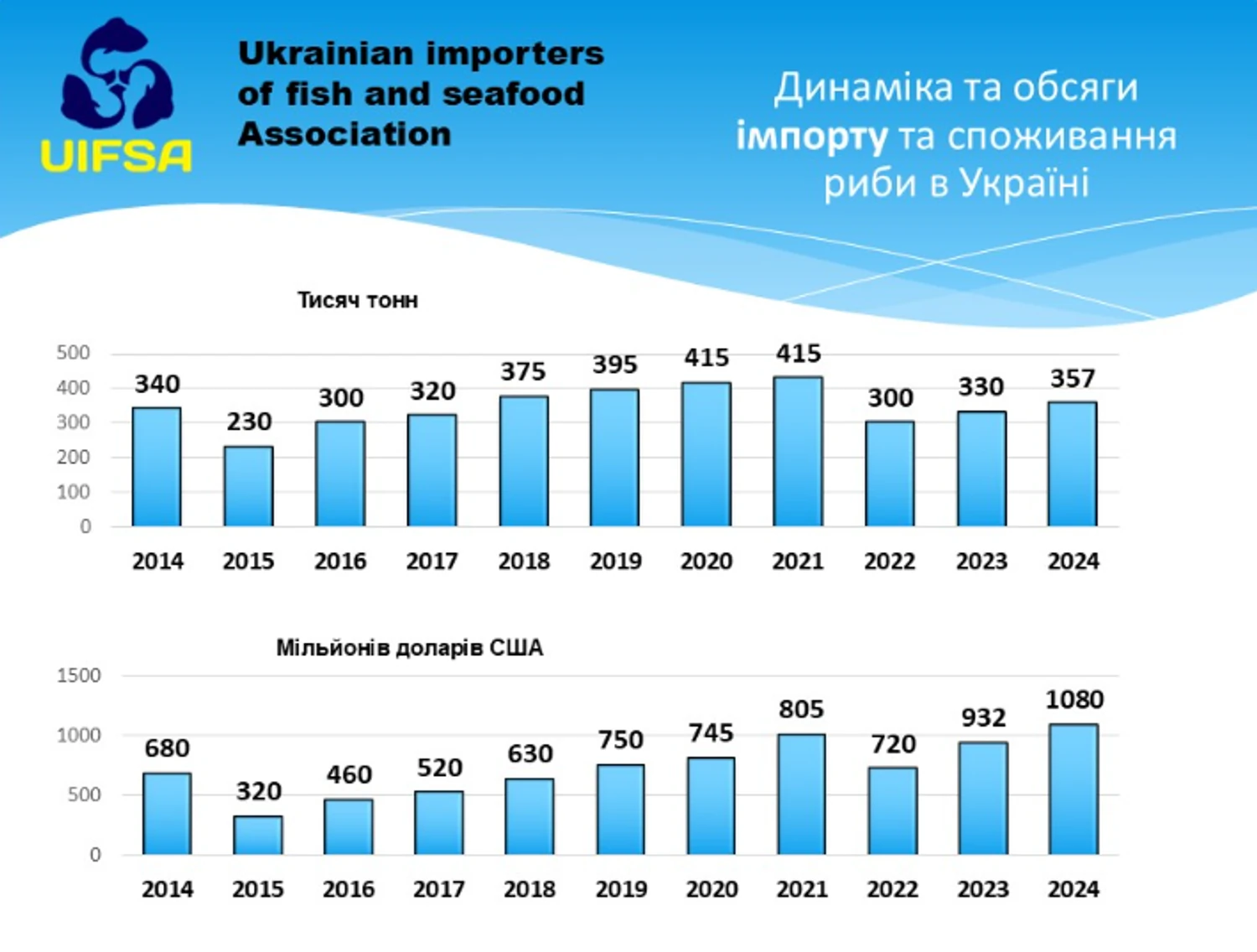
The key signal from the market is that Ukrainians, in general, have not abandoned fish as a category. According to the results of 2024, imports amounted to 357 thousand tons, and comparable figures for other years are close to this level. In monetary terms, there was an increase:
If in 2024 we imported fish for 1 billion 80 million dollars, then in 2025 this amount (was, – ed.) 1 billion 150 million
— Zahumennyi names specific figures.
He explains that these figures are important for two reasons.
Firstly, they indicate that demand has not "broken" even against the backdrop of a general decline in incomes and migration.
Secondly, this explains the "behavior" of prices: when purchase volumes are maintained, the main pressure on retail value is created not by a shortage of goods, but by associated costs and macro factors.
Since part of the population has left, overall consumption in absolute terms may seem stable, but in per capita terms, the average consumption level may even slightly increase
— said the expert.
This is rather an indicator of demand structure: fish is bought by those who remain, but they try not to abandon the category completely, more often changing the type or format of purchase.
Currency – as the main lever of fish and seafood prices
The fish market in Ukraine is structurally import-dependent: over 90% of products are imported from abroad and purchased in foreign currency. In such a model, the exchange rate becomes the main driver of the hryvnia price even when the world price for a specific fish hardly changes.
A striking example, which the CEO of the Association of Ukrainian Importers of Fish and Seafood uses to explain the pricing model, is hake. It has maintained approximately the same price corridor (around $2 per kilogram) in world markets in recent years. However, for the Ukrainian consumer, it is important not only how much fish costs in dollars, but also what exchange rate is in effect at the time of purchase and sale.
But the Ukrainian hryvnia price depends on the exchange rate at the time of purchase and sale. When (the dollar cost, – ed.) less than 40 hryvnias, it was one cost. Now the rate has jumped to 43-47 hryvnias. This is a completely different story for the consumer
— emphasizes Dmytro Zahumennyi.
He stresses that pricing is determined by objective factors that companies do not directly influence.
"The price is influenced by those objective factors that the subject themselves does not influence. They already adapt to the realities," the expert summarized.
Among the adaptation methods in the arsenal of market participants are procurement optimization, assortment review, and inventory management. They can also hold older batches longer to smooth out the "money shock" for the buyer.
But when currency pressure is prolonged, it will inevitably be reflected in the retail price for the consumer.
Logistics: when the sea was replaced by trucks and how it affects the price
The second basic factor is delivery. Before the full-scale war, a significant part of large consignments went by sea routes, which is usually cheaper per ton. After 2022, logistics significantly restructured: imports through EU countries, transit hubs, and the predominance of road transport increased costs.
Many transported by sea. That was one cost. Then the war started. They began to import through Lithuania, through Poland, Romania. The cost increased because everything is transported by road
— the CEO of the Association of Ukrainian Importers of Fish and Seafood told UNN.
Additional pressure on logistics was exerted by crisis episodes at the border. When blockades occurred and transport stood in queues at the borders, carriers raised tariffs, and businesses received not only more expensive delivery but also the risk of disrupting the cold chain and losing quality. Even if the acute phases of blockades have passed, logistics remain sensitive to queues, fuel costs, insurance, fleet repairs, and route changes.
As a result, the logistical component is "sewn" into the final bill very simply: the more expensive the delivery, the less room for promotions, discounts, and price stabilization in the mass segment.
Why blackouts also "cost a pretty penny" to fish buyers
The third factor that has become systemic for fish and seafood pricing in wartime years is the cost of energy autonomy.
Fish requires a stable "cold chain": warehouses, freezers, logistics centers, stores. Power outages forced the market to invest in generators and spend significant amounts of fuel to maintain the operation of refrigeration equipment.
"Large players have generators. But this is also a significant component that affects the cost of products," notes the UNN interlocutor in a comment.
Retail chains also include similar costs in their margin.
Dmytro Zahumennyi, to illustrate, cited a telling detail about retail that clearly explains why "generator" costs sooner or later push prices up.
ATB spends 30 thousand liters (of fuel, – ed.) every day. Multiply that by 60 hryvnias (the average cost of a liter of fuel) and you get a cosmic figure." And then the standard logic of trade kicks in: retail chains include their costs, and this also affects the final cost for the consumer
— explained the expert.
However, it should be understood that the degree of impact differs depending on the business model. Some have their own warehouse facilities and incur maximum costs for autonomy. Some work with short chains or fast turnover, reducing storage time. But the general principle is the same: electricity and fuel become part of the "invisible tax" in the price of fish.
Was there a general price jump in the "fish" market?
Despite the complex pressure of three factors, market participants do not record a massive price increase across the entire assortment simultaneously. For most items, prices remained relatively stable compared to previous months and even the previous year.
95% of fish products have approximately the same price as a month ago, half a year ago, and last year
— said Dmytro Zahumennyi.
However, exceptions exist, and they are usually related to global fishing restrictions or changes in supply for certain species.
The most striking example of a localized price increase is mackerel. This is a wild fish, the catch of which is regulated by quotas. When scientific assessments indicate a reduction in stocks, quotas can be decreased. Environmentally, this is logical, but economically, it means less supply and a higher purchase price.
"As a result of quota reductions, the price of mackerel at the purchase level almost doubled: from approximately $3/kg to levels close to $5/kg. In retail, this is felt even more strongly, especially in the segment of smoked products, where processing costs, energy, and trade margin are added to the price: compared to the summer period, the price could shift from "300+" to the "500+" zone per kilogram," commented the CEO of the Association of Ukrainian Importers of Fish and Seafood on the "mackerel case."
At the same time, the economic effect on demand is predictable. When mackerel approaches the price of more expensive types of fish, some consumers reduce purchases or look for substitutes. This does not mean the disappearance of demand as such, but it means a shift to other positions.
The market balances the situation, and the consumer looks for a substitute for the basket: the Ukrainian example
One of the reasons why the market does not "break down" from every localized jump is the consumer's ability to substitute types of fish. If one item suddenly becomes more expensive, it can often be replaced by another, cheaper or simply more accessible at a given moment.
According to Dmytro Zahumennyi, this works best in the white fish segment, where the choice is wider. In the red fish niche, there is less room for substitution, but even there, demand can shift between formats (steaks, fillets, sliced, frozen or chilled products).
This substitution mechanism partially "dampens" the consequences of price shocks: demand does not disappear but is redistributed among positions, maintaining overall sales volumes.
Stability with dependence on spring and exchange rates: how much will fish cost in the coming months?
Market estimates for the coming months generally boil down to maintaining current price levels, unless there is a new sharp deterioration of basic factors.
Among the conditions that could reduce pressure are seasonal relief in the energy system in spring and a potential decrease in exchange rate pressure.
Dmytro Zahumennyi says: if the hryvnia exchange rate rolls back closer to 41-42 UAH/USD, it could have a tangible effect on hryvnia prices, though not immediate, because the market works with batches and inventories. Separately, fishing seasonality plays a role: for some types of fish, the highest prices fall in the autumn period, while in subsequent seasons, a decrease in price is possible due to replenishment of supply. For mackerel, given the fishing season in autumn and winter, the seasonal factor can also change price dynamics, but its impact depends on quotas and overall supply.
The role of the state in pricing: why the market asks not to regulate it manually
In discussions about state regulation, market participants tend to believe that excessive administrative intervention creates obstacles and harms competition.
The CEO of the Association of Ukrainian Importers of Fish and Seafood explains: the fish market is competitive. A significant number of entities operate in it, and it is competition, according to industry representatives, that regulates prices better than manual restrictions, which often have side effects: shortages, "gray" trade, deterioration of quality, or shifting costs to other price components.
It is better for state regulation not to interfere. The market will regulate everything itself. Over a hundred entities operate there, and any administrative obstacles will hinder them
— he is confident.
At the same time, the UNN interlocutor acknowledges the importance of the general macro-financial background, particularly external support for Ukraine, which helps stabilize the budget and, indirectly, the economic situation. Therefore, for the buyer, the practical result is this: the assortment on the shelves is generally preserved, and there has been no sharp "washing out" of goods.
Geography of supplies and demand structure: what remains stable
Another price-stabilizing factor is the relatively unchanged structure of imports and consumer habits. After the shock of 2022, the market gradually recovered and reached a certain plateau.
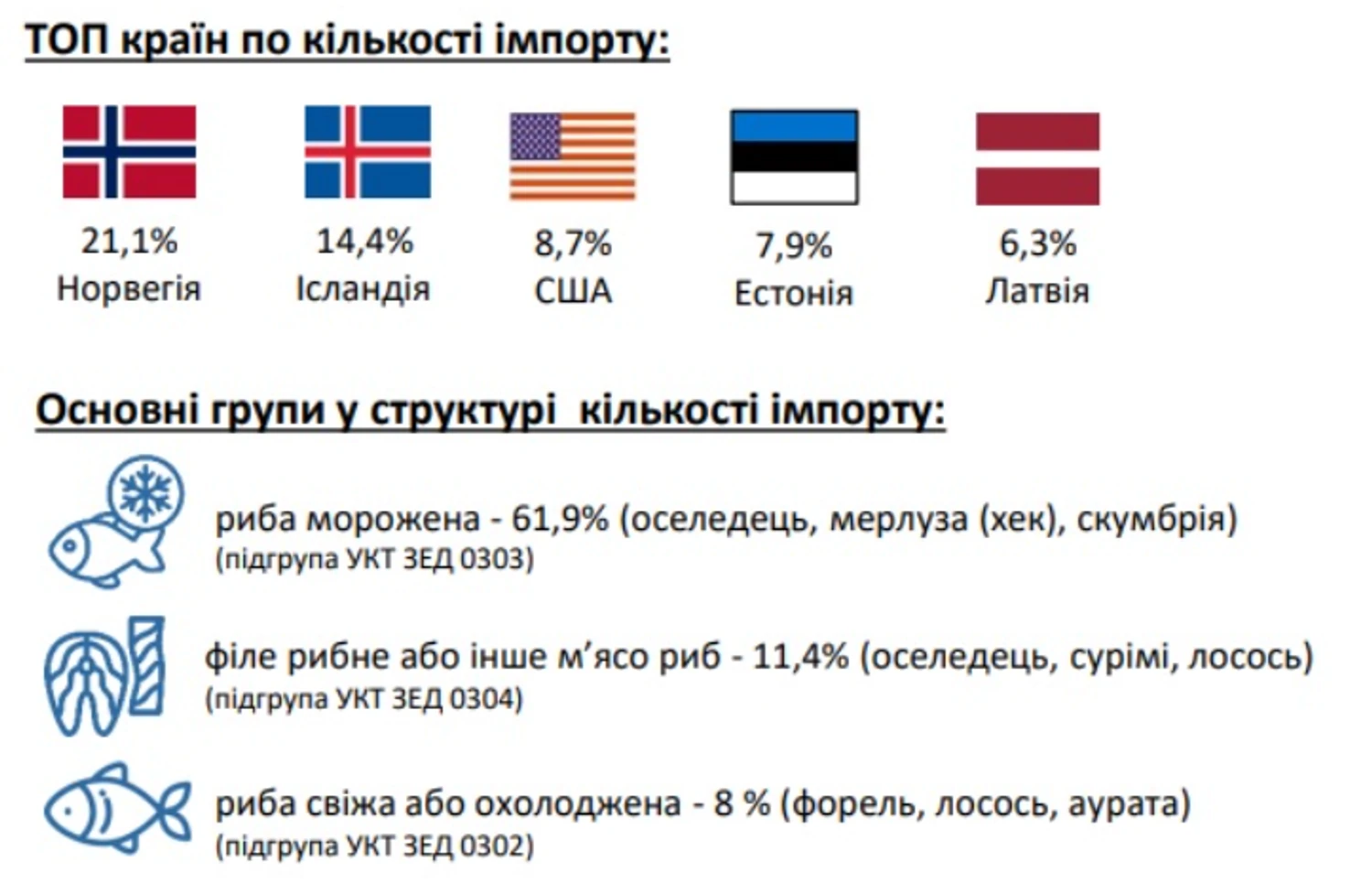
"Among the key suppliers, Norway (especially for herring and mackerel), Iceland, the USA (especially for pollock), and other countries are traditionally named. In the consumption structure, top positions also remain approximately the same from year to year, which adds inertia and predictability to the market," Zahumennyi explains to readers.
This means a simple thing: for prices to "go up" across the entire assortment, either a large-scale shock in basic costs in Ukraine (exchange rate, energy, logistics) or a significant supply shock in world markets for several key species simultaneously is needed.
Therefore, the Ukrainian fish market in 2026 is based not on cheapness, but on adaptation. The basic price is formed by three "iron" components: currency purchase, delivery, and costs for energy autonomy. Market participants do not see a massive price increase across the entire assortment, but localized price jumps are possible (and mackerel has already become a clear example of how fishing quotas can quickly change reality on the shelf).
If energy problems indeed ease in spring, and the hryvnia exchange rate weakens its "import tax," the market has a chance to get through the coming months without a new wave of price increases.
But the imported "nature" of the fish shelf makes it too sensitive to external and macroeconomic changes, and therefore complete and final stability should not be expected here.
